
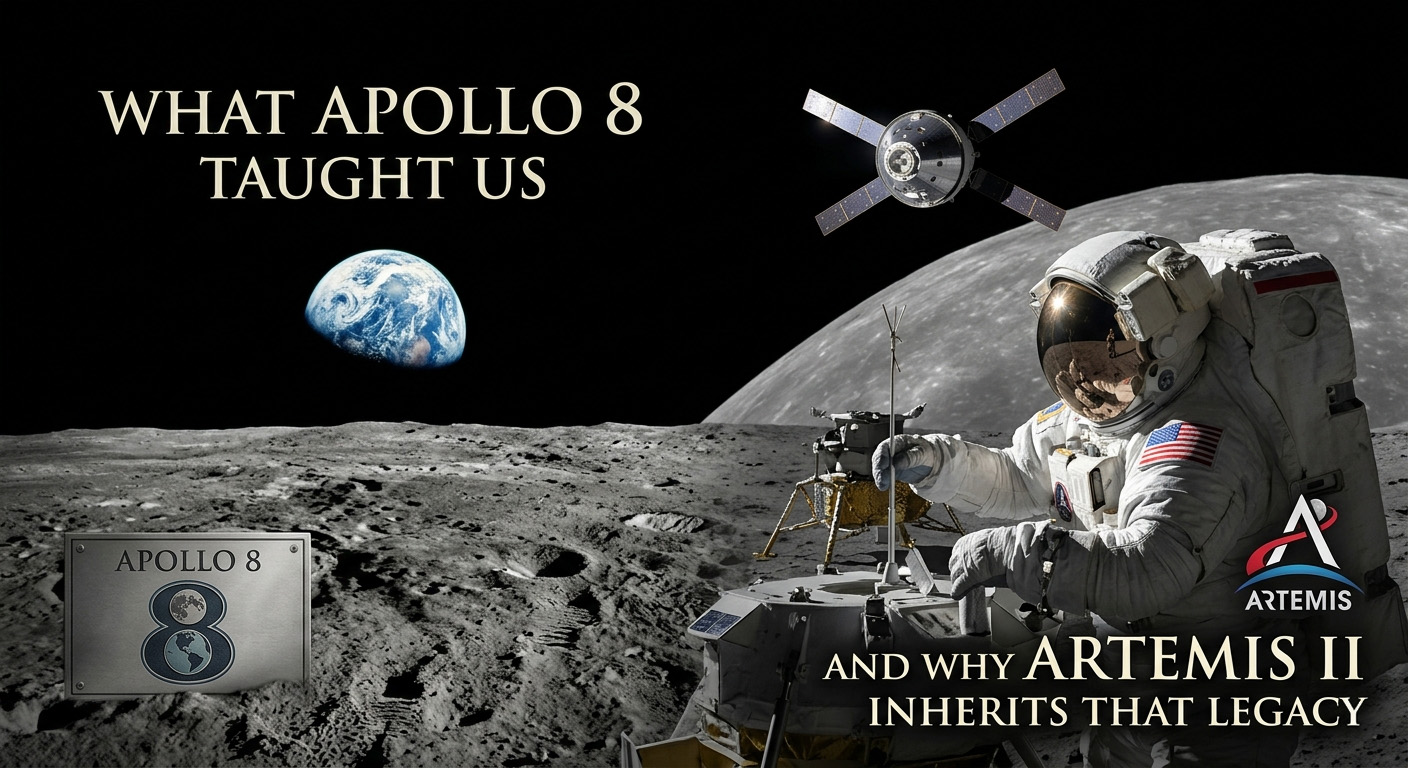
Today, for the first time in over 50 years, humans are heading back toward the Moon.
At 6:24 p.m. EDT on April 1, 2026, NASA’s Space Launch System is scheduled to carry four astronauts — Reid Wiseman, Victor Glover, Christina Koch, and Canada’s Jeremy Hansen — on a ten-day arc around the Moon and back. It’s a test flight, not a landing. It’s a “can we still do this?” before the real work begins. Which means it has more in common with Apollo 8 than it might first appear.
Apollo 8 launched on December 21, 1968, as the first crewed mission to leave Earth orbit and reach the Moon. It wasn’t supposed to be. The mission was originally planned as an Earth-orbital test of the Lunar Module — but the LM wasn’t ready, the schedule was slipping, and the Soviets were rumored to be planning their own lunar flyby. So NASA made a gutsy call: send the crew to the Moon anyway, LM or not, and figure out what happens.
What happened turned out to be extraordinary — and almost none of it was in the flight plan.
The Moments That Weren’t in the Script
“Oh My God, Look at That Picture”
As Apollo 8 was rotating to photograph the lunar surface during its fourth orbit, Bill Anders glanced up and saw something that stopped him cold: the Earth, blue and whole, rising above the gray lunar horizon. There was no Earth photography scheduled. The flight plan called for pictures of the Moon.
Anders scrambled for color film. Frank Borman wasn’t sure it was worth the trouble. They argued for a few seconds — the kind of terse, clipped argument that happens between professionals under pressure — and then Anders got the shot.
Earthrise became one of the most reproduced photographs in history. It helped launch the modern environmental movement. It changed the way humanity thought about the planet it lived on. And it happened because a crew member looked up at the wrong moment and grabbed a camera.
As a photographer, that moment resonates. The best shots often come from seeing something you weren’t looking for.
“Please Be Informed, There Is a Santa Claus”
On Christmas morning, 1968, Apollo 8 disappeared behind the Moon for the Trans-Earth Injection burn — the critical engine firing that would either send them home or leave them in lunar orbit forever. Mission Control could do nothing but wait. When the spacecraft reappeared and Jim Lovell’s voice crackled back across 240,000 miles, he said: “Please be informed, there is a Santa Claus.”
It wasn’t in the script. It was a man telling the world — with characteristic astronaut understatement — that they were alive and coming home.
The Christmas Eve Broadcast
The night before, on Christmas Eve, the crew did something nobody had planned in any operational sense: they held a live television broadcast from lunar orbit and read the first ten verses of Genesis. It was the most-watched television program in history at that moment. Borman ended it simply: “Good night, good luck, a Merry Christmas, and God bless all of you — all of you on the Good Earth.”
Nobody told them to do it that way. They chose the words themselves, in orbit, around the Moon.
First Eyes on the Farside
The mission profile required the crew to pass behind the Moon — they knew that going in. What they couldn’t fully anticipate was what it would feel like to be the first human beings to see the lunar farside with their own eyes. The heavily cratered, ancient terrain that faces permanently away from Earth had only been seen in Soviet photographs. The crew saw it in person. There’s no way to plan for a moment like that; you can only put people in the position to experience it.
The Navigation Mistake That Saved Apollo 13
Here’s the one that doesn’t get told often enough. During navigation checks, Jim Lovell accidentally entered data that caused the guidance computer to think the spacecraft was still sitting on the launchpad. The computer dutifully fired thrusters to “correct” its orientation. Lovell had to manually realign the system — working through the star charts and procedures by hand, recovering from a mistake that could have been genuinely dangerous.
Sixteen months later, on Apollo 13, when an oxygen tank exploded and the crew had to shut down the Command Module and navigate home from the crippled Lunar Module, it was Lovell’s hands-on experience with manual realignment that helped bring three men back alive. A mistake on Apollo 8 became a skill on Apollo 13. You can’t plan for that either.
Why This Matters for Artemis II
Artemis II isn’t Apollo 8. The crew won’t orbit the Moon — they’ll fly a free-return trajectory around it and head back. The mission is explicitly a test: verify the SLS rocket, verify Orion, verify that four human beings can survive the radiation environment of deep space with modern hardware.
But the parallels are real. Both missions are “first crewed” flights of new systems. Both are designed to prove capability before the actual landing attempt. Both carry crews into an environment no human has visited in a very long time — in Artemis II’s case, more than 50 years.
And both missions, if history is any guide, will produce moments that weren’t in the flight plan.
Reid Wiseman, Victor Glover, Christina Koch, and Jeremy Hansen are heading somewhere the vast majority of humans have never been, in a spacecraft that has never carried a crew, on a rocket that has flown exactly once before. Whatever they see, whatever they say, whatever small miscalculation or improvised decision shapes the mission in ways nobody anticipated — those are the moments history remembers.
The planned moments are important. But it’s the unplanned ones that change everything.
Artemis II launches today, April 1, 2026, from Kennedy Space Center’s Launch Complex 39B. The launch window opens at 6:24 p.m. EDT. Coverage is available on NASA+, YouTube, Amazon Prime, and CBS.
The crew: Commander Reid Wiseman, Pilot Victor Glover, Mission Specialist Christina Koch (all NASA), and Mission Specialist Jeremy Hansen (Canadian Space Agency). This is the first crewed mission beyond low Earth orbit since Apollo 17 in December 1972.
Leave a Reply